Explore More Music Tools
 Create beats, melodies, and songs.
 See sound frequencies over time.
 Build repeating percussion patterns.
 Make short melodies on a grid.
 Hear three-note chord sounds.
 Play chord tones in patterns.
 Watch notes flow like a roll.
 Turn drawings into sound.
 Change frequency and wave types.
 See sound move through air.
 Explore overtones and intervals.
 Compare string length and pitch.
 Spin voice speed and direction.
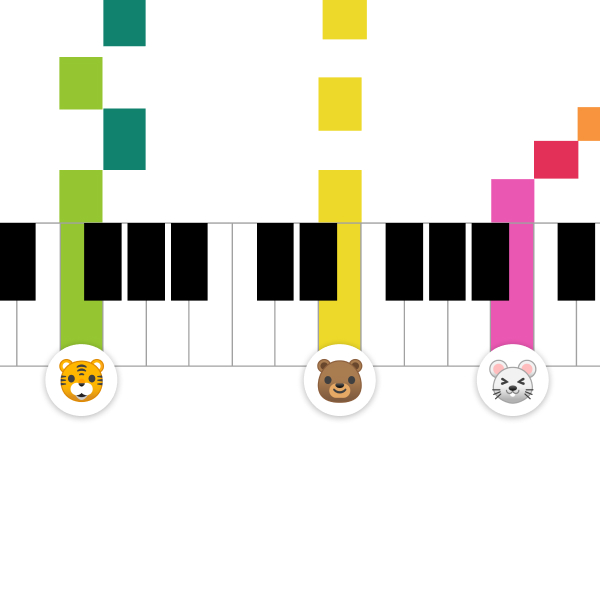 Share a live piano room.
Free online arpeggio tool
Arpeggios
Use Arpeggios to hear chord tones one note at a time. Explore broken chords, repeating patterns, and the way harmony can create movement in music.
Hear Broken Chords
An arpeggio uses the notes of a chord, but plays them separately. This makes harmony feel like a moving line instead of one block of sound.
Explore Musical Motion
Changing the pattern changes the sense of direction. Arpeggios can sound rising, falling, steady, or restless depending on the order of the notes.
Ways to Use Arpeggios
Choose a Chord
Start with a chord and listen to how its notes form a repeating pattern.
Change Direction
Try rising and falling patterns to hear how direction changes musical energy.
Support a Melody
Use arpeggios as a simple accompaniment idea behind a melody.
Practice Harmony
Connect arpeggios with chords to understand how harmony can become motion.
What Arpeggios Teach
Arpeggios connect harmony and melody. They use chord tones, but because the notes happen one at a time, they create a moving line that still points back to the underlying chord.
Hear Pattern and Direction
A rising arpeggio can feel like it is building energy, while a falling pattern can feel more relaxed. Changing note order is a simple way to shape musical motion.
Arpeggio Practice Ideas
Start With One Chord
Listen to the same chord tones in different orders to hear how pattern changes the phrase.
Try Rising Motion
Use low-to-high movement when you want the pattern to feel like it is lifting or opening up.
Try Falling Motion
Use high-to-low movement when you want the pattern to feel calmer or more settled.
Build Accompaniment
Repeat an arpeggio behind a melody idea to create motion without changing chords too quickly.
For Composing and Arranging
Arpeggios are useful when a plain chord feels too static. They can fill space, create a repeating texture, or make a simple harmony feel more active.
Connect to Chords
Try the Chords tool first to hear the harmony as a block, then use Arpeggios to hear the same kind of harmonic idea spread across time.
FAQ
What is an arpeggio?
An arpeggio plays the notes of a chord one at a time instead of all at once.
What can I learn from Arpeggios?
You can hear how chord tones form patterns, create movement, and outline harmony.
Are arpeggios useful for composing?
Yes. Arpeggios can create accompaniment patterns, bass lines, and melodic movement from chords.
Is Arpeggios free?
Yes. You can explore arpeggios in a browser without an account or installation.
How are arpeggios different from chords?
A chord plays several notes together, while an arpeggio plays those chord tones one after another.
Where are arpeggios used in music?
Arpeggios are common in accompaniments, bass lines, piano patterns, guitar picking, and melodies that outline harmony.